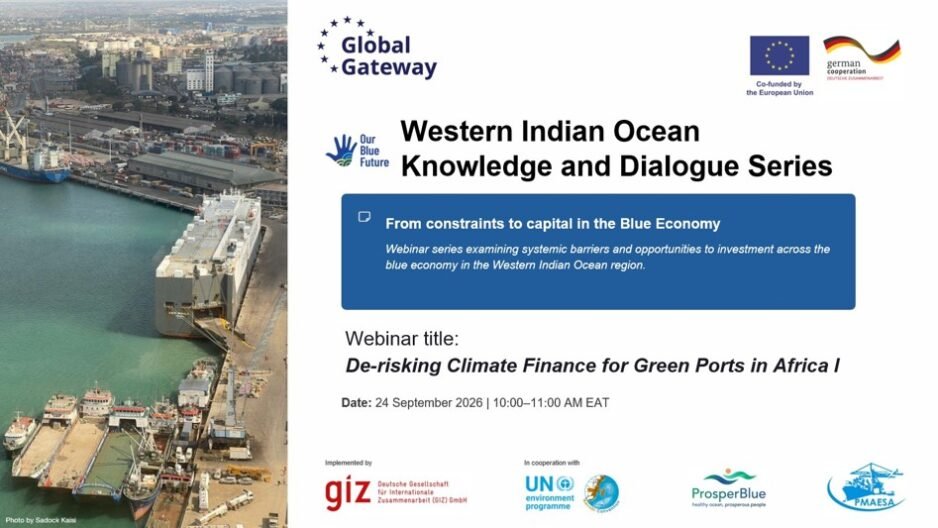
On 24 September 2026, Our Blue Future, through GIZ’s ProsperBlue Programme and in cooperation with PMAESA, convened the first of a two-part discussion on de-risking Climate Finance for Green Ports in Africa, the fourth session in the WIO Knowledge and Dialogue Series.
The session brought together perspectives from port operations, maritime regulation and international negotiation, transport corridors and logistics, and the private sector, moderated by Mwai Kibaki Jr of Climate Gateway Africa.
It was deliberately designed as the demand side of the conversation. Before financiers set out what they are prepared to fund, the aim was to hear what ports and maritime businesses actually need.
The question has changed
Shipping accounts for close to 3 per cent of global greenhouse gas emissions. Vessels sit at berth running diesel generators to power lighting, refrigeration and cargo handling, releasing emissions directly into port cities and the communities around them. The International Maritime Organization’s 2023 strategy commits the sector to cutting emissions by at least 20 per cent by 2030 and reaching net zero by or around 2050, and from 2030 the European Union will require container and passenger ships at its major ports to connect to shore power.
Against that backdrop, the question is no longer whether African ports should go green. Many already have strategies, the technologies largely exist, and shipping lines are under growing pressure of their own. The question is how those strategies become financed and delivered projects. Projects of this scale are unlikely to be financed by one institution or one type of capital. They need the port, the energy and technology providers, an offtaker, commercial lenders, and often guarantees, concessional capital or first-loss support from development institutions willing to absorb early-stage risk.
Strategy is not the same as implementation
A distinction drawn early in the discussion ran through the rest of the hour: having a strategy and implementing projects are two different things. In a port that must stay operational around the clock, the transition has to be gradual and practical.
What that looks like in practice is starting with measures that reduce consumption before investing in new energy infrastructure. LED lighting and more efficient cooling in buildings, then port lighting, then rooftop solar, then the electrification and hybridisation of port equipment alongside terminal operators. Several ports in the region have moved past the strategy stage and have a pipeline of further investments. The challenge is scaling up.
Electrification is right, but the energy source decides the outcome
One of the most important points raised was also the easiest to pass over. A port can electrify its cranes and harbour craft and install shore power at its berths, but the value of that switch depends entirely on how the electricity was generated in the first place.
Where a national grid is heavily renewable, electrification delivers immediately. Where a grid still runs substantially on imported fossil fuels, electrification relocates emissions rather than eliminating them. It remains worth doing, because it cuts local air pollution in port cities, reduces engine running hours and maintenance costs, and positions the port for a cleaner grid later. But it should be understood for what it is at that stage.
This is why shore power and grid decarbonisation need to be planned together rather than sequentially, and why some ports are pairing electrification with their own generation, feeding rooftop solar directly into shore power supply. Reliability and sufficiency matter as much as carbon intensity. A supply that is clean but intermittent cannot serve a port that operates continuously.
The same logic extends beyond the port gates. Cargo arrives by diesel truck from the hinterland, passes through inland terminals running diesel handling equipment, and leaves on a vessel burning conventional fuel. A green port is one link in a longer chain, and greening the most visible link is not the same as addressing the most material one.
The gap between technical feasibility and financial viability
A recurring theme was that funding for studies is comparatively accessible while funding for implementation is not. Ports described completing feasibility work confirming a project was technically sound, then stalling at the point where detailed engineering, procurement and construction require capital.
The underlying issue is that technical feasibility and financial viability are separate tests. A shore power installation can be entirely sound engineering and still fail conventional investment criteria, because several of its benefits, cleaner air and reduced emissions, do not appear in the port authority’s financial returns. The unresolved questions tend to be commercial rather than technical: how frequently vessels will actually use the installation, what the electricity will cost, who finances the infrastructure, and how the investment is recovered.
This is precisely the space blended finance is meant to occupy. Not replacing commercial capital, but absorbing enough early risk to make a project commercially financeable. The specific ask from the session was for support that continues past the feasibility stage, through detailed engineering and procurement to implementation, and for far more investment in project preparation.
From policy to pipeline
Green port policy does not sit within the port alone. It cuts across energy, investment, labour, customs and revenue authorities, which means it has to emanate from national action plans rather than port level intent. Where that alignment exists, international ambition functions as a market signal that can be translated into specific, financeable projects. Where it does not, policy remains an environmental obligation to be met rather than an investment opportunity to be developed.
The point was made directly: green shipping strategies should not be treated as compliance or environmental programmes. They should be converted into investment pipelines. Project preparation was repeatedly named as the weak link, and Africa’s difficulty in reaching bankability was attributed more to preparation than to a shortage of viable ideas.
Fuels present a particular version of the same problem. Fuel producers want certainty that ships will buy, while shipowners want certainty that fuel will be available at scale and at an acceptable price. Someone has to move first, or someone has to underwrite the risk of moving first.
Complementarity rather than competition
One of the more constructive threads was the case for ports playing to different strengths rather than each building the same facilities. A country generating a high share of its electricity from renewables is positioned differently from an island economy well placed to serve as a regional bunkering hub. Seen that way, individual port projects begin to look like segments of a regional green corridor, which also changes how they might be financed and who might finance them.
The regional trade agenda strengthens that case. Green corridors and cleaner port services are as much a competitiveness and industrialisation question as an environmental one.
Who participates in the transition
The transition has to work commercially. A greener port can also be a more productive port, with less energy waste, better reliability and shorter vessel and cargo dwell times. That reframing matters, because it moves clean ports from an environmental proposition to a competitiveness and infrastructure proposition, and it changes who is willing to pay for them.
It also has to work for more than a few firms. The transition creates work in emissions monitoring and data, waste reception, hull cleaning, ship repair, the supply of cleaner fuels, and skills. Much of that is work smaller enterprises could do. But procurement systems built for large buyers, financing structured over ten years against contracts awarded for one or two, and the cost and time of new certification requirements all work against them. Unless those barriers are designed out deliberately, the transition will reproduce the concentration that already exists in port systems.
A related point was made about foundations. Technology and finance are essential but cannot deliver change on their own. Shared objectives, clear responsibilities, fairly shared costs and benefits, and promises kept are what hold a corridor together, and different partners need different incentives because they are motivated by different things. Customers respond to price and reliability, investors to returns on manageable risk, operators to efficiency and secure business.
Looking ahead
The session closed on a clear challenge: many ports in the region already have strong green strategies, and the task now is ensuring those strategies become projects that are financed, implemented and delivered.
That is the agenda for the second part of this dialogue, where development agencies, financiers, technology providers and the wider shipping industry will be asked to respond to what was raised here. Who carries the early risk, who funds project preparation, how implementation gets financed once feasibility is complete, and how the transition is structured to build competitiveness and broad participation rather than compliance alone.
This session was hosted by Our Blue Future in cooperation with PMAESA and the GIZ ProsperBlue Programme.