The Western Indian Ocean is home to some of the world’s most biodiverse and economically significant coastal ecosystems, making it a globally attractive tourism destination. Yet marine and coastal tourism in the region remains structurally underfunded and disconnected from formal investment pipelines. Fragmented business models, limited investor familiarity with the sector, and a lack of structured financing pathways for SMEs continue to hold back an industry with significant potential for both inclusive economic value and conservation impact.
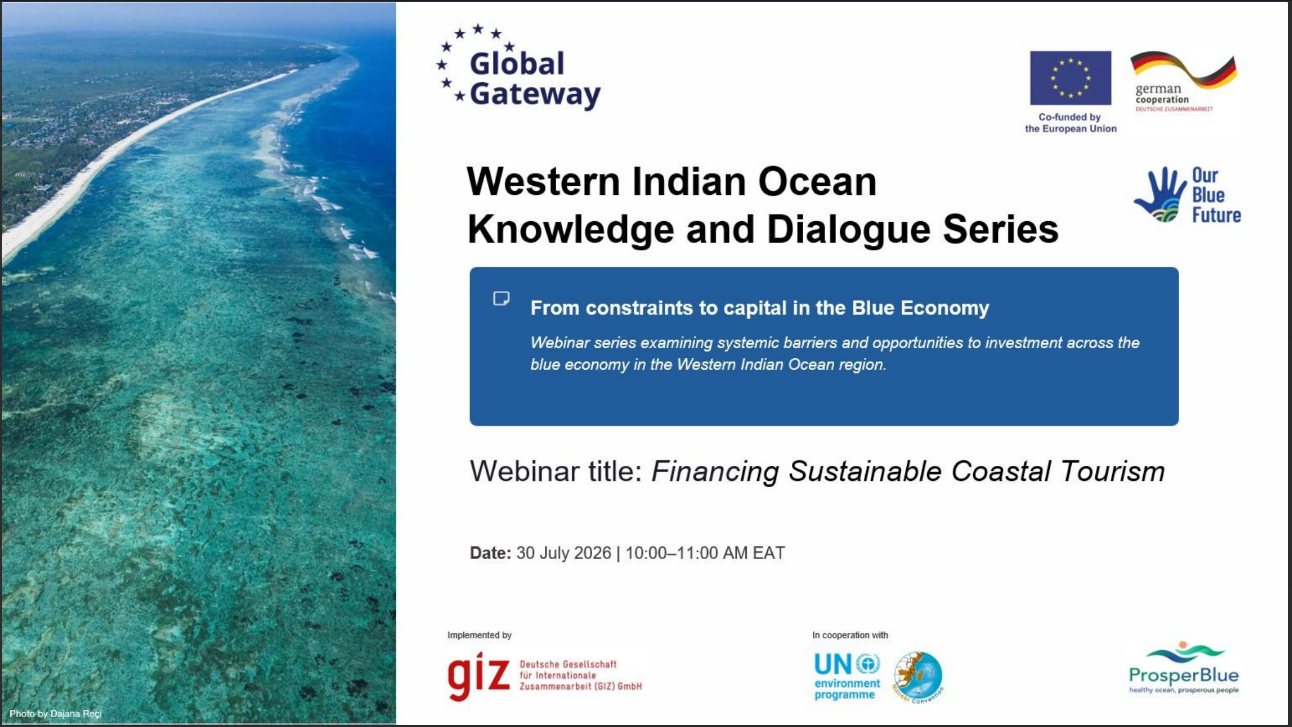
To examine these barriers, Our Blue Future, in association with GIZ through the ProsperBlue Programme, and co-funded by the EU Global Gateway, convened a webinar on 30 July 2026 under the Western Indian Ocean Knowledge and Dialogue Series. Titled Financing Sustainable Coastal Tourism, the session was moderated by Giulia Balestracci, Tourism Policy and Project Officer at Eco-union, and brought together four speakers spanning hotel development advisory, tourism operator financing, blended and impact investment, and a grassroots enterprise case study. The panel featured Håvar Bauck, Founder of HotelOnline; Apiyo Aloo, CEO and Managing Director of Ankara & Lustar Hotel Development Advisory; Azmyra Merchant, Associate Director at ACCT Fund; and Anneloes Roelandschap, Co-founder and CEO of Chako Zanzibar. The session drew 96 registered participants from across the region and beyond, with sustained engagement throughout.
Bankability, not capital scarcity, is the real barrier
A central theme of the discussion was the distinction between business viability and bankability. Most small and independent coastal hotels are viable, in that they survive and generate income, yet only a small proportion could pass a basic bankability test today. The gap is largely one of documentation. Funders require property management system records, audited or management accounts, and clear booking data, rather than informal records. The most actionable recommendation raised across the session was the development of a simple, professionally prepared data room that any tourism business, not only hotels, could share with a funder on request.
ESG capital funds ecosystems, not amenities
The panel observed that sustainability is still frequently treated as an afterthought in investment pitches, when ESG-oriented capital is in fact assessing the wider ecosystem around a project: environmental stewardship, a genuine social contract with the local community, local procurement, and sound governance. The historical coastal development model, which walled off land, imported materials, and served only international visitors, is increasingly being displaced as regional travel grows and as investors reward projects that build community inclusion in from the concept stage. Skipping rigorous market and financial feasibility work at the planning stage was repeatedly linked to projects that later face receivership or forced repositioning.
Patient capital is the instrument the sector needs
Across all four speakers, a shared conclusion emerged: coastal tourism requires patient capital structured around the realities of the sector, including long ramp-up periods, thin margins, and pronounced seasonality, rather than conventional repayment terms. The recommended approach blends grants for project preparation and public goods, first-loss capital or guarantees to de-risk and crowd in local lenders, patient local-currency debt with seasonal repayment profiles, and equity used selectively rather than by default. Capital was described as stalling at three consistent points: the concept stage, where projects are designed without local context; the documentation stage, where financial and environmental records are incomplete; and the currency and exit-risk stage, where local-currency revenue sits against costs denominated in hard currency.
Risk is being mispriced, not only managed
A recurring observation was that international investors often treat the continent as a single, undifferentiated risk category rather than assessing the specific operator or asset in question. In practice, many coastal operators carry a natural hedge, as foreign-visitor pricing tends to move with dollar or euro inflation even where revenue is collected locally, while long operating track records and strong forward bookings indicate that repayment performance is often stronger than the applied risk premium suggests. Catalytic capital, in the form of first-loss tranches, partial guarantees, or subordinated capital, was identified as the near-term tool to correct this mispricing and give conventional investors the confidence to participate.
From funding projects to financing enterprises
Enterprises built around circular-economy and conservation outcomes face a distinct missing middle: too commercial for grant funding, as they already generate revenue, yet too small or early-stage for conventional commercial finance. Drawing on the Chako Zanzibar case study, the panel recommended directing new capital toward strengthening enterprises that have already demonstrated they can sell, by investing in production capacity, market access, export readiness, and management systems, rather than funding another short-term project. Success, in this framing, is defined by financial resilience and self-generated income rather than the ability to attract outside investment.
Local identity and community inclusion drive long-term value
Local sourcing, authentic guest experiences, and community buy-in were raised repeatedly as drivers of value rather than as costs. Panellists highlighted co-funding local production capacity in place of imported goods, building destination-wide rather than resort-isolated sustainability initiatives, and shifting guest offerings toward local cuisine and culture, as today’s travellers increasingly seek immersive and authentic experiences. Examples were cited on both sides, including community-backed projects that attracted institutional financing, and a coastal asset whose value eroded once community buy-in broke down. The panel also flagged untapped potential in youth-led local experience offerings as a low-cost entry point into the wider tourism value chain.
Conclusion
Coastal tourism financing in the Western Indian Ocean is entering a decisive phase. The region’s ecological and economic potential is not in question; the constraint, as the panel made clear, is not a shortage of capital but a shortage of bankable, well-documented, and community-inclusive pipelines. The immediate priorities raised across the session were consistent: build documentation and data-room capacity at the operator level; design capital instruments around the sector’s real seasonality and risk profile rather than generic terms; correct the mispricing of risk through better data and track record; and shift financing logic from short-term projects toward durable, revenue-generating enterprises. Above all, the coastal communities that shape the guest experience and steward these ecosystems must be treated as central to bankability, rather than as an afterthought to it.