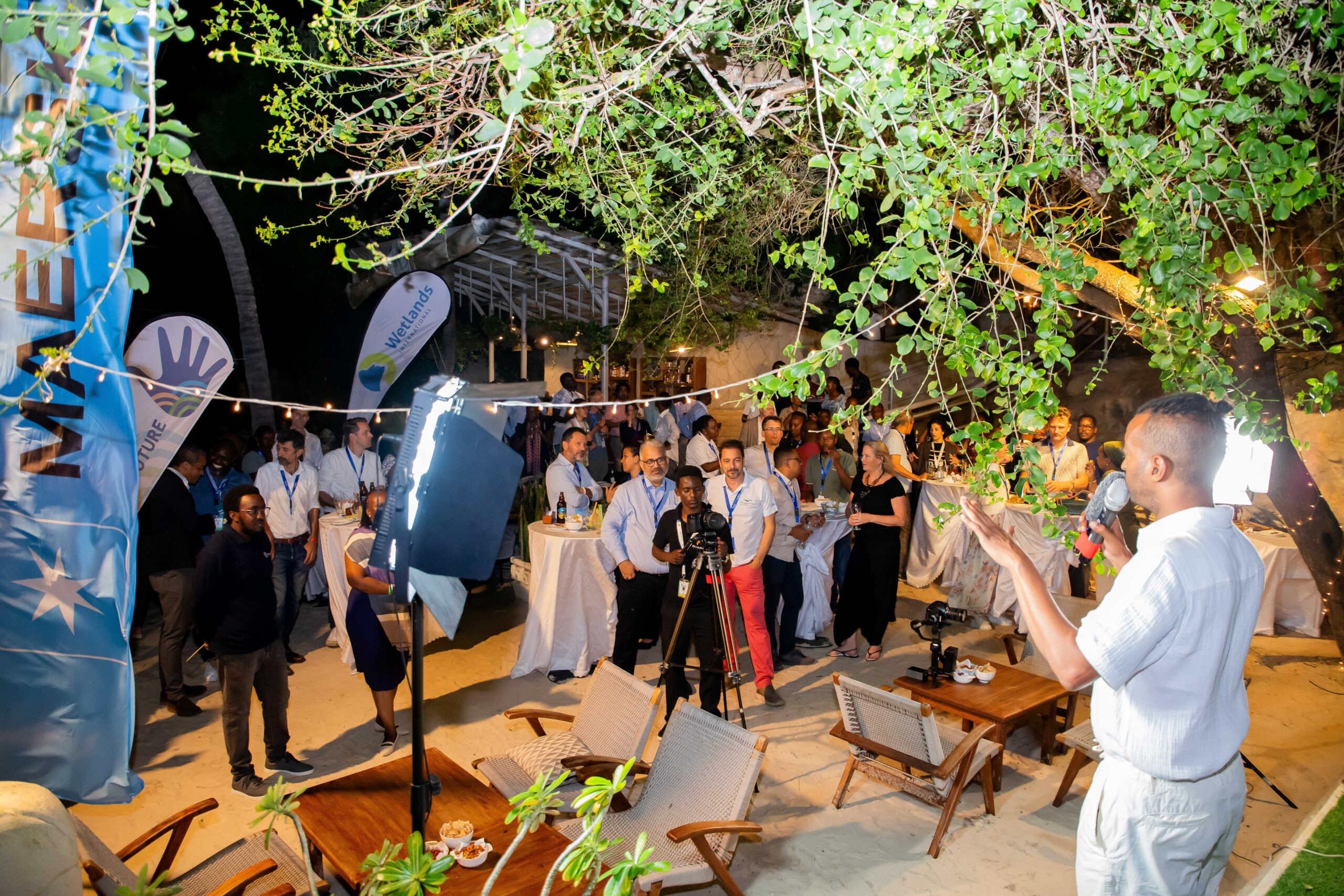
On 8 September 2026, Our Blue Future, through GIZ’s ProsperBlue Programme, convened a roundtable discussion on Unlocking Blue Carbon Finance in the Western Indian Ocean, the third session in the WIO Knowledge and Dialogue Series.
The session brought together perspectives from marine science and community practice, carbon market technology, and donor and blended finance, moderated by Desmond Tutu Owuoth of ACNBS Advisory.
The conversation centred on two connected questions: how do we make WIO blue carbon projects genuinely investable, and how do we ensure communities capture a fair and meaningful share of the value?
The WIO opportunity and the problem
The Western Indian Ocean holds an estimated 3.5 million hectares of mangroves and seagrass, storing roughly 1.3 billion tonnes of carbon. The potential is enormous, but most blue carbon projects in the region are not yet structured to attract investment. Verification costs alone can consume 30 to 50 percent of annual carbon revenue for small community sites, and deal structures often favour intermediaries over the communities doing the conservation work.
Four pillars that must mature together
The discussion was framed around four pillars that must advance in tandem for blue capital to flow: policy that creates legal certainty, science and technology that make natural capital measurable, finance that converts project pipelines into appropriately priced capital, and governance that ensures legitimacy and fair allocation of benefits. Weakness in any one pillar can render an otherwise attractive project unbankable or socially unsustainable.
Science and community ownership: The foundation
The WIO has the science, the policy frameworks, and the community buy in. The bottleneck is not readiness. It is how investors approach these ecosystems without understanding the systems they are entering. Investors sometimes pursue thousands of hectares of mangrove planting without understanding the ecological, social, and regulatory complexity of the system they are working within.
Several principles have kept successful WIO blue carbon projects credible: robust and replicable carbon accounting methodologies, community-led standards such as Plan Vivo, which requires at least 60 per cent of benefits to flow directly to communities, genuine community ownership where members vote on project goals, financial transparency, and strong partnerships spanning research institutions, government agencies, and international collaborators.
The panel also stressed the risk of over-relying on carbon revenue alone. Stacking revenue streams, combining carbon with fisheries, ecotourism, mangrove honey, and biodiversity credits, diversifies the investment portfolio and builds community resilience. Biodiversity offset models piloted alongside mangrove carbon are already showing promise in the region.
Technology: Lowering the cost barrier
Digital MRV is changing blue carbon economics. Platforms using remote sensing, satellite imagery, and algorithmic modelling can automate the manual verification work that currently drives costs. Deforestation history, carbon stock estimates, biodiversity signals, growth predictions, soil type, terrain, and climate data can all be derived remotely without ever touching the land.
The key insight from the discussion: a blue carbon project becomes too small to be investable when the cost of proving it is real exceeds what it can earn. Technology can push that threshold much lower, bringing smaller community projects into an investable pipeline. However, all models, data sources, and calculations must remain fully transparent and auditable for the market to trust digital MRV.
Donor capital: Funding what private capital will not
Donor capital is essential for the pre-investable stage: community engagement, ecological assessments, skills development, governance structures, and parallel livelihood projects that sustain communities while carbon revenues mature. One example cited during the session was a project in West Africa where donor investment entered at a stage when carbon revenues were still years away, and no private investor would have participated.
The “missing middle” was a recurring theme. Many enterprises are too advanced for grants but not yet ready for commercial finance. What is needed is more technical assistance, stronger internal governance, concessional finance, and patient capital to bridge the gap.
The panel also offered practical guidance for communities negotiating with carbon brokers: insist on clear fixed percentages of gross revenue, avoid contracts exceeding 10 to 20 years without review, protect traditional fishing and cultural access rights, ensure dispute resolution falls under domestic law, and avoid clauses that transfer ownership or penalise communities for natural events beyond their control.
Policy and regulation: The enabling environment
Governments can do several things to unlock more blue carbon investment: establish clear legal frameworks that define carbon sequestration rights, provide long term tenure security, streamline permitting so approvals do not overlap across ministries, and integrate explicit blue carbon targets into Nationally Determined Contributions. Private capital is not held back by lack of interest, but by regulatory uncertainty.
Kenya’s experience was highlighted as a positive example. The country has developed a National Mangrove Management Plan, a Seagrass Strategy, and has recently launched a Blue Carbon Ecosystem NDC Investment and Implementation Plan, creating the kind of anchoring that projects need to scale.
Looking ahead
The session made clear that making WIO blue carbon projects investable and equitable is not a single problem to solve but a set of interlocking challenges that require science, technology, finance, and governance to advance together. When strong science, community participation, and empowered government institutions come together, there is a real pathway to leveraging the holistic management of these ecosystems for climate, community, and biodiversity benefits.
This session was hosted by Our Blue Future in cooperation with the GIZ ProsperBlue Program.
n 8 September 2026, Our Blue Future, through GIZ’s ProsperBlue Programme, convened a roundtable discussion on Unlocking Blue Carbon Finance in the Western Indian Ocean, the third session in the WIO Knowledge and Dialogue Series.
The session brought together perspectives from marine science and community practice, carbon market technology, and donor and blended finance, moderated by Desmond Tutu Owuoth of ACNBS Advisory.
The conversation centred on two connected questions: how do we make WIO blue carbon projects genuinely investable, and how do we ensure communities capture a fair and meaningful share of the value?
The WIO opportunity and the problem
The Western Indian Ocean holds an estimated 3.5 million hectares of mangroves and seagrass, storing roughly 1.3 billion tonnes of carbon. The potential is enormous, but most blue carbon projects in the region are not yet structured to attract investment. Verification costs alone can consume 30 to 50 percent of annual carbon revenue for small community sites, and deal structures often favour intermediaries over the communities doing the conservation work.
Four pillars that must mature together
The discussion was framed around four pillars that must advance in tandem for blue capital to flow: policy that creates legal certainty, science and technology that make natural capital measurable, finance that converts project pipelines into appropriately priced capital, and governance that ensures legitimacy and fair allocation of benefits. Weakness in any one pillar can render an otherwise attractive project unbankable or socially unsustainable.
Science and community ownership: The foundation
The WIO has the science, the policy frameworks, and the community buy in. The bottleneck is not readiness. It is how investors approach these ecosystems without understanding the systems they are entering. Investors sometimes pursue thousands of hectares of mangrove planting without understanding the ecological, social, and regulatory complexity of the system they are working within.
Several principles have kept successful WIO blue carbon projects credible: robust and replicable carbon accounting methodologies, community-led standards such as Plan Vivo, which requires at least 60 per cent of benefits to flow directly to communities, genuine community ownership where members vote on project goals, financial transparency, and strong partnerships spanning research institutions, government agencies, and international collaborators.
The panel also stressed the risk of over-relying on carbon revenue alone. Stacking revenue streams, combining carbon with fisheries, ecotourism, mangrove honey, and biodiversity credits, diversifies the investment portfolio and builds community resilience. Biodiversity offset models piloted alongside mangrove carbon are already showing promise in the region.
Technology: Lowering the cost barrier
Digital MRV is changing blue carbon economics. Platforms using remote sensing, satellite imagery, and algorithmic modelling can automate the manual verification work that currently drives costs. Deforestation history, carbon stock estimates, biodiversity signals, growth predictions, soil type, terrain, and climate data can all be derived remotely without ever touching the land.
The key insight from the discussion: a blue carbon project becomes too small to be investable when the cost of proving it is real exceeds what it can earn. Technology can push that threshold much lower, bringing smaller community projects into an investable pipeline. However, all models, data sources, and calculations must remain fully transparent and auditable for the market to trust digital MRV.
Donor capital: Funding what private capital will not
Donor capital is essential for the pre-investable stage: community engagement, ecological assessments, skills development, governance structures, and parallel livelihood projects that sustain communities while carbon revenues mature. One example cited during the session was a project in West Africa where donor investment entered at a stage when carbon revenues were still years away, and no private investor would have participated.
The “missing middle” was a recurring theme. Many enterprises are too advanced for grants but not yet ready for commercial finance. What is needed is more technical assistance, stronger internal governance, concessional finance, and patient capital to bridge the gap.
The panel also offered practical guidance for communities negotiating with carbon brokers: insist on clear fixed percentages of gross revenue, avoid contracts exceeding 10 to 20 years without review, protect traditional fishing and cultural access rights, ensure dispute resolution falls under domestic law, and avoid clauses that transfer ownership or penalise communities for natural events beyond their control.
Policy and regulation: The enabling environment
Governments can do several things to unlock more blue carbon investment: establish clear legal frameworks that define carbon sequestration rights, provide long term tenure security, streamline permitting so approvals do not overlap across ministries, and integrate explicit blue carbon targets into Nationally Determined Contributions. Private capital is not held back by lack of interest, but by regulatory uncertainty.
Kenya’s experience was highlighted as a positive example. The country has developed a National Mangrove Management Plan, a Seagrass Strategy, and has recently launched a Blue Carbon Ecosystem NDC Investment and Implementation Plan, creating the kind of anchoring that projects need to scale.
Looking ahead
The session made clear that making WIO blue carbon projects investable and equitable is not a single problem to solve but a set of interlocking challenges that require science, technology, finance, and governance to advance together. When strong science, community participation, and empowered government institutions come together, there is a real pathway to leveraging the holistic management of these ecosystems for climate, community, and biodiversity benefits.
This session was hosted by Our Blue Future in cooperation with the GIZ ProsperBlue Program.